Cross-Linked XLPO: The Sheath Chemistry in Plain Terms
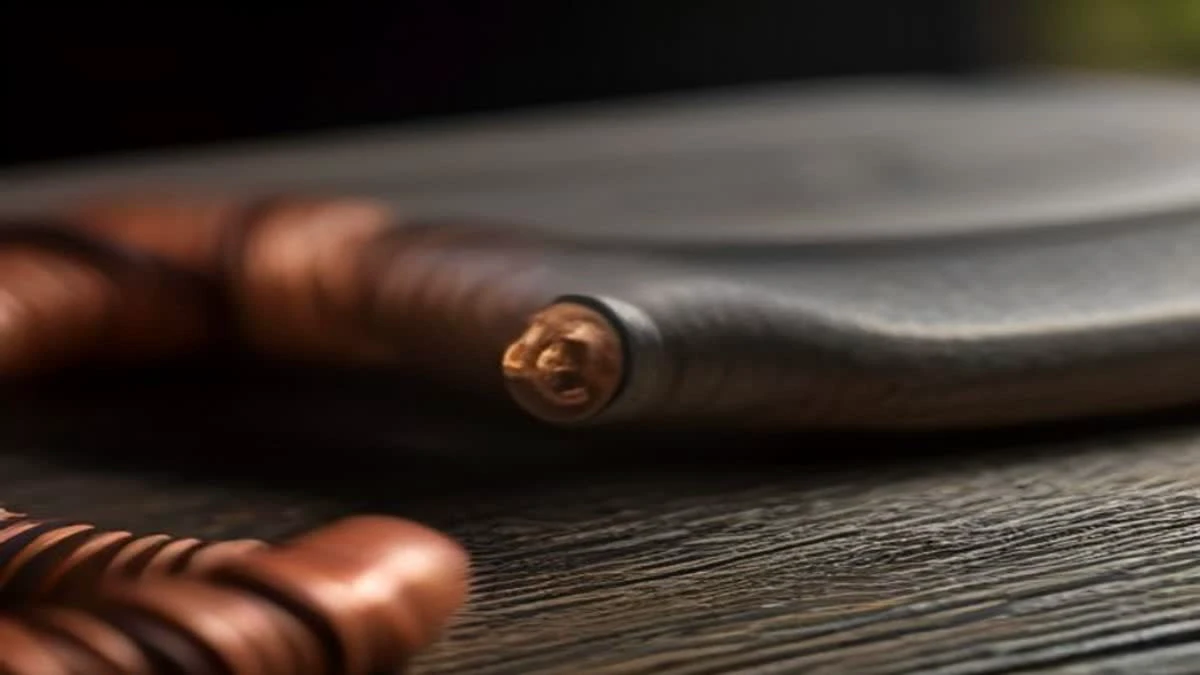
XLPO stands for cross-linked polyolefin, and the cross-linking on the manufacturer's 1500 V solar cable is done with an electron beam rather than with heat or chemicals. What that buys the cable is a sheath that keeps its shape when the conductor inside it gets warm. The published construction names XLPO for both the insulation and the sheath, electron-beam cross-linked and low smoke halogen free, in black or red.
Key takeaways
- Published construction on the 1500 V cable: XLPO insulation and XLPO sheath, electron-beam cross-linked and low smoke halogen free.
- Published thickness is 0.7 mm of insulation and 0.8 mm of sheath on the 1.5 mm² to 10 mm² sizes, widening to 0.9–1.7 mm and 0.8–1.7 mm on larger sections.
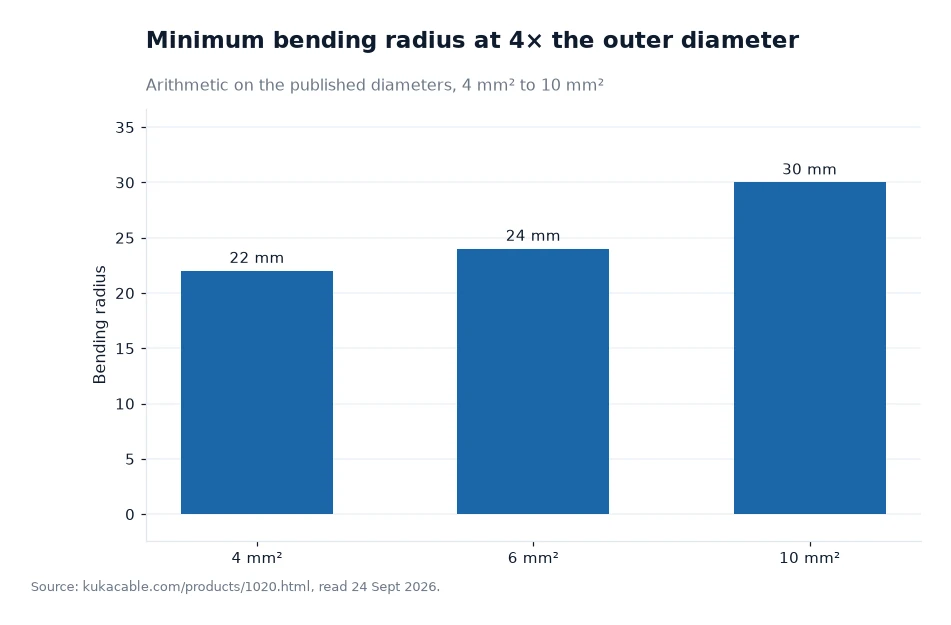
- The same page lists a vertical flame test at 800 °C for one minute and a minimum bending radius of 4 × the outer diameter.
- KUKA CABLE states that its PV cables typically reach up to 185% elongation, against the more than 125% required by EN 50618.
What cross-linking actually does
A thermoplastic softens when it is heated and hardens again when it cools. A cross-linked polyolefin does not behave that way, because the polymer chains have been joined to each other in a three-dimensional network. Heat still softens the material a little, but the network stops it flowing. That is the whole point of choosing XLPO for a cable that sits on a roof: the conductor can reach the published short-circuit values and the sheath around it will not sag away from the copper.
Electron-beam cross-linking does the joining with a beam of high-energy electrons instead of a curing bath or a peroxide additive. The cable passes through the beam after extrusion, and the dose sets the degree of cross-linking. The manufacturer states the process rather than leaving the compound name alone, which matters because XLPO produced by different routes behaves differently at high temperature.
Why the sheath is cross-linked as well as the insulation
Many PV cables cross-link the insulation and leave the sheath as a conventional thermoplastic. The published construction here names XLPO for both layers. The reason shows up in handling: the sheath is the part that is dragged over a roof tile, pressed by a clip and walked on during maintenance, and it is the layer that receives the ultraviolet dose. A cross-linked sheath resists deformation at the clip, so the wall thickness under the clip stays close to the wall thickness in the middle of the span.
The word in the same published line is halogen free, and its partner term is low smoke. Halogen-free compounds do not release the acidic gases that PVC does when it burns, and low smoke means the cable contributes less to the obscuration that makes an installation hard to evacuate. In a rooftop installation the cable sits beneath modules, not above a public corridor, but the same property is why halogen-free compounds are specified in enclosed electrical rooms. The manufacturer keeps a content section on solar cable that covers construction, characteristics and the dangers of cutting corners.
Published construction, layer by layer
| Layer | Material | Thickness, 1.5–10 mm² | Thickness, larger sizes |
|---|---|---|---|
| Conductor | Tinned copper, class 5 flexible to IEC 60228 | Not applicable | Not applicable |
| Insulation | XLPO, electron-beam cross-linked, low smoke halogen free | 0.7 mm | 0.9–1.7 mm |
| Sheath | XLPO, electron-beam cross-linked, low smoke halogen free | 0.8 mm | 0.8–1.7 mm |
| Colour | Black or red | Both | Both |
| Rated voltage | DC 1.8/1.8 kV | Whole range | Whole range |
Read the table as a stack rather than a list. The conductor is the flexible core, the insulation is the electrical barrier that must not break down, and the sheath is the mechanical and environmental shield. Only one of those three layers is allowed to be compromised by sun, and it is not the insulation.
Heat, flame and the properties that follow
The temperature envelope published with that construction on the 1500 V product page is −40 °C to +90 °C ambient, +120 °C for 20,000 hours and +250 °C for 5 seconds on short circuit. Mechanical values are a tensile strength of at least 8 N/mm² and an elongation of at least 125% before ageing; the manufacturer states that its PV cables typically run about 20% above the requirement and reach up to 185%.
The flame behaviour is published as a vertical test: a single cable exposed to burning at 800 °C for one minute, after which it should extinguish itself. That is a demanding field for a cross-linked polyolefin, and it is the property that separates a halogen-free compound from a filled PVC sheath, which burns and releases acid gas. The standards named for this construction are TUV 2PfG 1169/08.2007, EN 50618:2014 and IEC 62930, so a specifier can compare the compound against a named type test instead of a description. The laboratory that runs these checks was established in December 2015 and is described as an ISO/IEC 17025 facility, with a 2,000-hour xenon lamp test equivalent to about 360 weathering cycles arranged on the manufacturer's cables.
Worked example
The published rule is a minimum bending radius of 4 × the outer diameter. The published diameters are 5.5 mm at 4 mm², 6.0 mm at 6 mm² and 7.5 mm at 10 mm². Multiplying gives radii of 22 mm, 24 mm and 30 mm. Those three products are the author's own arithmetic on published figures, and they are rounded to the nearest millimetre for clarity.
Now compare that with the wall thicknesses. Bending a 10 mm² cable to a 30 mm radius compresses the inside of a 0.7 mm insulation wall and stretches the outside of a 0.8 mm sheath. The material has to accommodate that strain without yielding, which is exactly what the published elongation of up to 185% describes. A stiff thermoplastic sheath at the same radius would show stress whitening long before the cable failed electrically.
Frequently asked questions
Why does the manufacturer cross-link the sheath and not only the insulation?
The published construction names XLPO for both layers on the 1500 V cable. The sheath takes the mechanical load on the rack, the abrasion during pulling and the ultraviolet dose, so a cross-linked sheath holds its wall thickness under a clip and resists the surface cracking that a thermoplastic would show after years of exposure.
Does a cross-linked sheath change the electrical ratings?
The electrical ratings published with that construction are DC 1.8/1.8 kV, a spark test at 10 kV during production and 6.5 kV AC for 5 minutes on the finished cable. Those are insulation properties. What the sheath adds is mechanical protection, so a thicker or better cross-linked sheath does not raise the voltage rating, it protects the layer that carries it.
What to check on a compound declaration
Ask for the insulation and the sheath to be named separately, with the cross-linking route and the thickness for the size being ordered. A sheet that says only "XLPE" for both layers does not say enough, because the published construction here distinguishes electron-beam cross-linked XLPO with a low smoke halogen free formulation.
Then confirm the mechanical values and the bending radius, and set the minimum radius in the installation instruction rather than leaving it to the crew on the roof. Finally, ask whether samples and data sheets can be supplied for the size in question; the site offers both, and the product pages carry the download links.
XLPO and electron-beam cross-linking are explained as the manufacturer explains them on its own website, kukacable.com, scanned 24 Sept 2026[1].