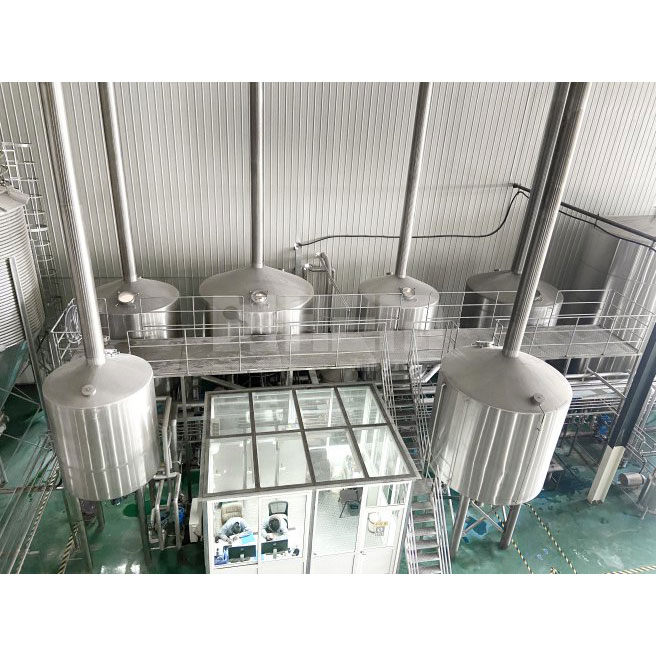
A new brewery needs equipment that can move beer through the full production cycle without one stage running out of capacity. A typical 10 BBL brewery starts with a malt mill, brewhouse, hot liquor tank, plate heat exchanger, fermenters, glycol chiller, pumps, CIP equipment, water treatment, CO₂ supply, cold storage, and kegging or canning equipment. One U.S. barrel equals 31 gallons, so a 10 BBL batch represents about 310 gallons before process losses. If packaged yield is 90%, roughly 279 gallons remain for sale. Fermenter quantity, rather than brewhouse size alone, often sets weekly output because beer may occupy a tank for 14–28 days.
Equipment sizing should start with planned beer volume. A brewery targeting 1,500 BBL per year and brewing 10 BBL batches needs about 150 finished batches before losses. At an 88–92% packaged yield, annual hot-side production may need to reach roughly 1,630–1,705 BBL. A five-day production week does not require brewing every day, but the cellar must hold beer while fermentation, conditioning, carbonation, and quality checks continue.
A 10 BBL brewhouse is therefore not automatically a 10 BBL finished-beer system. Grain absorption, kettle trub, hop matter, yeast sediment, transfer loss, tank heel, filtration, and packaging can remove 5–12% of volume depending on beer style and process. High-hop beers may lose more because hop material retains liquid, so the next equipment choice should be based on flow between vessels rather than nominal vessel labels.
A 10 BBL vessel name describes nominal batch scale, not guaranteed packaged output. At 90% recovery, a nominal 10 BBL process produces about 9 BBL for packaging, equal to approximately 279 U.S. gallons.
Grain handling comes first in that flow. A two-roller mill is adequate for many small breweries, provided it can process the full grain bill before mash-in. A 10 BBL ale at moderate original gravity may use roughly 500–700 lb of malt, while stronger beer can exceed 800 lb. A mill rated at 1,000 lb per hour can therefore prepare a typical batch in well under one hour, leaving capacity for cleaning and the next brew.
The grist then enters the brewhouse, where vessel arrangement changes labor and daily throughput. A two-vessel system commonly combines mash/lauter functions in one vessel and kettle/whirlpool functions in another. It costs less and occupies less floor space, but vessel reuse limits overlapping batches. A three- or four-vessel brewhouse can support more turns per day because lautering, boiling, and whirlpool work can occur in separate vessels.
| Brewhouse size | Nominal batch volume | Typical startup use | Production consideration |
|---|---|---|---|
| 5 BBL | 155 gal | Small taproom | More brew days per unit sold |
| 7 BBL | 217 gal | Taproom plus local draft | Moderate cellar requirement |
| 10 BBL | 310 gal | Small production brewery | Common 10–20 BBL cellar pairing |
| 15 BBL | 465 gal | Regional draft/package sales | Higher utility and cold-side demand |
| 20 BBL | 620 gal | Larger production schedule | Packaging speed becomes more important |
The brewhouse also needs enough hot water at the right time. Mash water, sparge water, vessel rinsing, and cleaning can require several times the finished beer volume over a production day. If a 10 BBL brewery runs two turns, the hot liquor tank must refill and recover temperature fast enough to prevent the second batch from waiting. A tank around 1.5–2 times brewhouse volume is common in many layouts, although actual sizing depends on brewing schedule and heat recovery.
Wort leaving the kettle may be close to boiling temperature and must reach yeast-pitching temperature before entering the fermenter. A plate heat exchanger transfers heat from wort to water, and a properly selected unit can cool an entire batch during knockout rather than holding the brewhouse for another hour. A 10 BBL batch transferred in 45 minutes requires an average wort flow near 6.9 gallons per minute.
Cooling also creates recoverable energy. Water leaving the exchanger becomes warm enough for later brewing or cleaning when the system is designed for reuse. If 300 gallons of wort require a similar order of cooling-water volume under favorable inlet temperatures, retaining that heated water can lower the amount that must be heated again. This connection between heat exchange and water storage leads directly to the largest cold-side equipment group: fermentation tanks.
Fermenters should be counted by occupied days, not only batch count. If an ale stays in a unitank for 18 days and a brewery fills one tank every two production days, nine tanks may already be occupied before the first one becomes available again. A lager held for 30–42 days changes the same calculation substantially, even when weekly brewhouse output does not change.
A brewery can also pair one brewhouse with larger fermenters. Two 10 BBL turns can fill a 20 BBL unitank during the same day, reducing the number of vessels needed for a given cellar volume. The approach requires enough brewing hours, cooling capacity, and yeast planning to place both batches into the vessel under controlled conditions. A craft brewery system should therefore be specified around batch scheduling as well as total annual volume.
Fermenter construction affects how reliably that schedule works. Commercial unitanks normally use stainless steel construction, cooling jackets, temperature sensors, sanitary fittings, pressure relief hardware, CIP spray devices, and a conical bottom for yeast and solids collection. If a brewery expects 8 fermenters at launch and 12 by year three, glycol piping and control capacity should be planned for the later tank count even when the extra tanks are not purchased immediately.
Cellar space usually grows faster than brewhouse space because a wort batch may occupy the hot side for hours but occupy a fermenter for 2–6 weeks.
That residence time makes refrigeration sizing especially important. Active fermentation produces heat, while newly filled tanks may also need rapid temperature reduction. A chiller selected only from total tank volume can be misleading because peak demand may occur when several fermenters are active while another tank is being cooled. A system operating with 10 tanks does not necessarily experience 10 equal cooling loads at once, so heat calculations should include fermentation stage, desired pull-down time, room conditions, pipe length, and future tank additions.
Bright beer tanks can reduce fermenter occupancy when packaged volume grows. Beer can move from a fermenter after maturation into a BBT for carbonation, final conditioning, or packaging preparation, allowing the fermenter to receive another brew sooner. A brewery packaging 30% of output may manage with limited bright-tank capacity, while a business packaging 70–90% of production can benefit more from separating fermentation and packaging storage.
Moving beer between vessels requires sanitary pumps, hoses, valves, fittings, and piping that are often underestimated in equipment budgets. A brewery may have $200,000 or more invested in large stainless vessels yet still lose production time because only one suitable pump or transfer hose is available. Multiple transfer routes also need compatible connection standards so operators do not spend each brew day changing adapters.
Cleaning equipment belongs in the same capacity calculation. A tank that finishes beer at 08:00 cannot accept fresh wort at 09:00 if cleaning, rinsing, inspection, sanitizing, and preparation require several hours. A mobile CIP cart may work for a small operation; breweries with more vessels may use dedicated caustic, rinse, acid, and recovery tanks. Reusing properly controlled cleaning solution can also reduce chemical and water consumption compared with preparing a fresh full-volume solution for every vessel.
Water chemistry needs attention before the brewhouse is ordered. Hardness, alkalinity, chloride, sulfate, sodium, iron, and source-water consistency affect brewing and equipment selection. Reverse osmosis may be useful where mineral content is high or inconsistent, while another site may need only carbon filtration and targeted mineral adjustment. In 2026, there is still no single treatment package that suits every brewery because municipal and well-water profiles vary by location.
Packaging then determines how quickly beer can leave the cellar. Manual keg filling may be sufficient when most beer is sold through a taproom, while distribution changes the requirement. A small canning line running 15 cans per minute produces 900 cans per hour before stops; at 30 cans per minute, theoretical output doubles to 1,800. Actual throughput is lower after changeovers, cleaning, seam checks, label replenishment, and operator interruptions.
A 16-ounce can contains 0.125 U.S. gallons, so one 10 BBL batch at 90% packaged yield represents roughly 2,232 cans before additional packaging loss. At an effective rate of 20 cans per minute, filling alone takes almost 112 minutes. Cartoning, pallet handling, coding, rinse systems, dissolved-oxygen control, and cold storage add more time, which is why packaging capacity must be compared with weekly cellar releases.
Keg-focused breweries face a different equipment mix. One half-barrel keg holds 15.5 gallons, so 9 BBL of packaged beer fills about 18 standard half-barrel kegs. A brewery selling 80% of production on draft needs enough clean-keg inventory to cover beer stored at the brewery, beer in transit, and empty kegs waiting to return. Keg washing speed then determines whether reusable packaging is ready when a tank reaches release date.
Cold storage follows packaging because finished beer still occupies physical space. Forty half-barrel kegs require far less floor area than thousands of individual cans, while palletized cans need forklift or pallet-jack access and organized rotation. Refrigeration calculations should include door openings, room insulation, incoming product temperature, lighting, people, and summer ambient temperature rather than using room volume alone.
Gas supply also expands with packaging. CO₂ is used for tank purging, carbonation, transfers, keg preparation, and filling. Larger breweries may move from cylinders to bulk storage because frequent cylinder replacement interrupts production. Gas distribution should include suitable regulators and controlled pressure at each use point; ventilation and gas detection also matter because fermentation and packaging release CO₂ into occupied spaces.
Heating deserves the same planning. Electric systems can suit smaller brewhouses where adequate electrical service exists, while larger systems often use steam. A brewery that expects to increase from one brew per day in year one to three turns per day in year three must check whether its boiler, electrical service, hot-water storage, condensate handling, and makeup-water system can support the later schedule.
Quality-control equipment completes the production chain. At minimum, a commercial brewery benefits from calibrated temperature measurement, pH measurement, gravity or density measurement, accurate scales, carbonation checks, and documented batch records. A packaged brewery may add dissolved-oxygen measurement, microbiological sampling, seam inspection, and more detailed fermentation records as distribution grows. Even a 2% packaging loss becomes 30 BBL per year at 1,500 BBL production.
Equipment purchasing therefore works best when every item is attached to a number: barrels per batch, turns per day, occupied tank days, gallons per minute, cans per minute, cleaning hours, cold-storage positions, or annual packaged volume. A brewery with balanced 10 BBL equipment can produce more usable beer than a larger brewhouse connected to an undersized cellar, chiller, or packaging line.
Before placing an order, compare vessel working volume rather than only nominal size, jacket area, pressure rating, heating method, pump capacity, electrical requirements, connection standards, control hardware, platform dimensions, installation scope, spare parts, and commissioning support. A quotation issued in 2026 may describe two systems as 10 BBL packages while including very different pumps, valves, controls, insulation, piping, and utility hardware.
Floor drains, washable surfaces, ventilation, ceiling clearance, electrical panels, water supply, gas service, glycol routes, and equipment-access paths belong in the same equipment plan. Leaving space for four future fermenters may cost little during initial layout work, while relocating piping and drains after three years of operation can require removing equipment and interrupting production. Designing around realistic batch flow keeps later expansion tied to production needs rather than rebuilding the brewery around earlier layout limits.