Multi-category sourcing adds coordination across products that may use different factories, specifications, quality checks, and shipping needs. Buyers evaluating support should define the work required, who owns key decisions, how supplier and cost information will be shared, what evidence each product needs, and how exceptions will be handled. A service model is useful when its scope fits the project and its responsibilities are clear enough to manage.
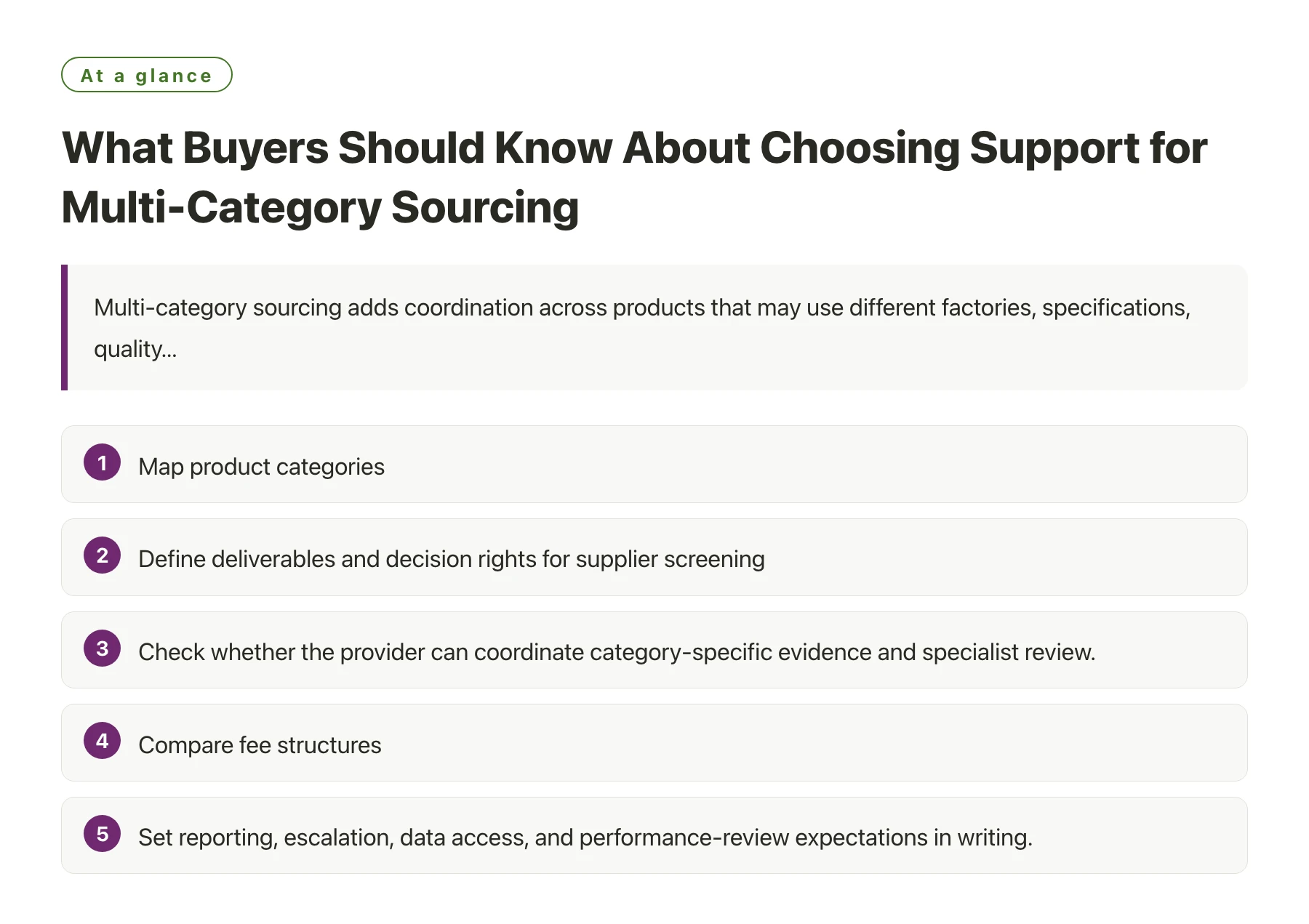
Key takeaways
- Map product categories, supplier count, quantities, destination, and schedule before selecting support.
- Define deliverables and decision rights for supplier screening, samples, orders, quality, and logistics.
- Check whether the provider can coordinate category-specific evidence and specialist review.
- Compare fee structures, disclosures, expenses, exclusions, and shipment assumptions.
- Set reporting, escalation, data access, and performance-review expectations in writing.
Evaluate providers against your actual product mix and internal capacity, not only a general service description.
Describe the portfolio and desired outcome
List each product category, estimated supplier count, order quantity, destination market, product risk, required arrival date, and any project or seasonal dependency. Note which items are repeat purchases and which require development. A portfolio with standard hardware, fragile finishes, regulated items, and custom furniture may need different sourcing and inspection work within one program.
State the outcome you need from support: supplier discovery, quotation comparison, factory verification, sample coordination, purchase follow-up, inspections, consolidation, or shipment documents. Prioritize essential outcomes and identify which tasks your team will retain. This helps determine whether a provider fills a real capability gap or duplicates work already assigned internally.
A service description such as JS Sourcing sourcing support in China should be translated into named tasks and deliverables. Ask for examples of what the provider will send, when it will be sent, and who on your team will make the decision.
Define responsibilities and decision rights
Create a responsibility map for buyer, provider, supplier, inspector, broker, carrier, and project team. Assign owners for technical requirements, supplier selection, commercial negotiation, sample approval, compliance review, inspection disposition, payment, customs declarations, and shipment release. A provider may coordinate communication without having authority to approve a product or waive a requirement.
Identify which decisions require written buyer approval and how urgent exceptions are escalated. For example, the provider may flag a proposed component substitution and collect evidence, while the buyer’s engineer decides whether it is acceptable. A clear separation prevents a schedule update or sourcing recommendation from being mistaken for technical or regulatory approval.
Define the provider’s access to supplier contacts, quotations, drawings, and quality records. Decide who owns those records, whether the buyer may contact factories directly, and how confidentiality or intellectual property is protected. These terms matter when the relationship ends or another team takes over the project.
Assess category expertise and verification
Ask how the provider approaches each category rather than relying on a broad claim of experience. Which product risks are likely to drive qualification? What supplier evidence is needed? Which components or processes are outsourced? Which technical questions require a specialist, laboratory, architect, engineer, or compliance owner? A credible process recognizes where additional expertise is required.
Request a sample workflow using a representative product brief. Observe how the provider turns requirements into supplier questions, compares quotes, tracks sample revisions, records gaps, and escalates decisions. Do not ask for confidential customer information; instead review a redacted process example or a hypothetical case that reveals how work is organized.
Check how the provider identifies the actual production site, trading relationships, and subcontracted processes. Ask what verification is performed and what remains based on supplier declarations. Record evidence and limitations separately. A factory visit, business license, certificate, or online listing may support a specific check but should not be described as proof of every capability or product claim.
Set product-specific quality and compliance controls
For every category, define the approved model, materials, sample process, critical characteristics, inspection timing, acceptance criteria, and change-control method. A single program can use a shared reporting format while maintaining different technical criteria for lighting, building products, consumer goods, or medical items. Do not let convenience turn into a generic checklist that misses the risks of a particular product.
Decide who selects acceptance sampling, laboratory tests, or specialist inspection and what evidence will be retained. If a sample or report supports a decision, tie it to model, configuration, factory, lot, method, and date. The provider may arrange these activities, but the buyer should know their scope and limitations before relying on results.
Define how nonconformities, corrective actions, concessions, and repeat inspections are handled. Set a hold and escalation route for findings that affect safety, regulatory evidence, functionality, or contractual requirements. Name the person authorized to accept a deviation and capture the decision against the exact product and quantity.
Compare fees, incentives, and expenses
Ask for the fee basis by task or project: fixed fee, hourly time, retainer, per-supplier charge, per-order charge, percentage, or other structure. Identify calculation base, minimums, included revisions, volume assumptions, payment timing, and what triggers extra work. A percentage may scale differently from a fixed fee as product value changes; compare total expected cost under the same portfolio and scope.
Request disclosure of commissions, rebates, supplier-side compensation, referral arrangements, or other incentives that could influence recommendations. Clarify who pays each provider and whether the buyer will see original supplier quotes and invoices. The agreement should make the commercial relationship understandable enough for the buyer to evaluate conflicts and control spend.
Set a process for reimbursable expenses: travel, samples, courier, translation, testing, storage, re-inspection, and urgent work. Define approval thresholds and supporting receipts. Separate provider fees from factory charges, freight, insurance, duties, customs brokerage, and destination handling so cost reports do not combine unlike items.
Review logistics coordination across categories
Ask how the provider gathers dimensions, weights, readiness dates, handling constraints, pickup locations, packaging information, and required documents from each supplier. The logistics plan should show which products can be consolidated, which need separate handling, and whether timing or storage conditions make a shared shipment unsuitable. Confirm whether the provider books transport or only shares information with the buyer’s forwarder.
State the delivery terms and named places in the relevant contracts. The U.S. International Trade Administration explains that Incoterms allocate defined tasks, costs, and risks between buyers and sellers, including transport, insurance, documentation, and customs activities. That allocation does not replace the project’s broader service agreement or remove the need to price other costs. [1]
Ask who reconciles commercial and shipping documents across multiple suppliers and who responds to broker queries. Confirm how lot, order, and product identifiers remain traceable in consolidated shipments. Define how late suppliers, partial releases, damaged goods, and customs delays are communicated and who can authorize an alternate plan.
Evaluate reporting and communication practices
Agree on an update cadence and a standard report showing supplier, product, current milestone, forecast, actual date, open issue, owner, decision needed, and cost impact. Ask for source documents or links when a status depends on a supplier statement. A dashboard is useful only if it is accurate, current, and tied to a clear action owner.
Identify response times for routine questions and escalation triggers for a missed milestone, quality issue, unapproved change, or required-document gap. Name primary and backup contacts in each organization. Decide how decisions are recorded when teams work across time zones and whether the provider summarizes calls or messages in a shared log.
Check language, file access, security, and retention practices. Decide where technical files and supplier records are stored, who may access them, and how they are returned or removed at contract end. Make sure the buyer can export records in a usable format if the provider relationship changes.
Run a bounded pilot and agree success measures
If the portfolio is new or complex, define a bounded initial scope such as a category, supplier shortlist, or one order cycle. The pilot should produce the same core deliverables the parties expect later: comparable quotes, sample log, risk register, milestone plan, cost visibility, and closeout record. Do not let a pilot leave ownership or commercial obligations undefined.
Set measures tied to controllable work: completeness of quotations, on-time status reporting, closure of open questions, accuracy of order records, quality of supplier evidence, and visibility of actual versus estimated cost. Avoid using sales or quality outcomes alone as proof of a provider’s contribution when factors are outside its control.
At the review, compare agreed scope with actual tasks, delays, extra fees, and decision quality. Identify whether internal bottlenecks or provider gaps caused issues. Adjust the responsibility map and service terms before expanding to other categories. Keep the pilot’s limitations visible so one product or supplier is not treated as a universal test of the model.
Put the operating agreement in writing
The agreement should name products or categories, deliverables, fee schedule, expenses, scope limits, payment conditions, confidentiality, records access, change process, termination, and dispute path. Attach the buyer’s brief or project schedule where it defines the work. List the provider’s subcontractors and the tasks they perform if that matters to confidentiality, data, or accountability.
Clarify how supplier recommendations are made and how conflicts are disclosed. State whether the provider can bind the buyer, approve samples, accept deviations, place orders, or authorize shipment. If the provider cannot make those decisions, identify who will respond and how quickly so a hold does not linger without an owner.
After each order, reconcile scope, fees, supplier performance, quality records, delivery, and outstanding obligations. Use the findings to refine future briefs and provider selection. A written operating model keeps multi-category work understandable as suppliers, product requirements, and internal teams change.
Sources
Frequently asked questions
Should one sourcing provider handle every product category?
It depends on the product mix, risk, and available expertise. Map category-specific needs and identify where specialist or internal review remains necessary.
What should be included in a sourcing support agreement?
Define the tasks, deliverables, fees, reimbursable expenses, exclusions, decision rights, access to records, confidentiality, change process, escalation path, and termination terms.
Can a provider approve samples on behalf of the buyer?
Only if the buyer explicitly delegates that authority. The agreement should state the scope, criteria, limits, and records for any delegated approval.
How can a buyer compare provider fees fairly?
Normalize the same product mix, supplier count, service scope, expenses, fee basis, and delivery assumptions, then compare total expected cost and responsibility.