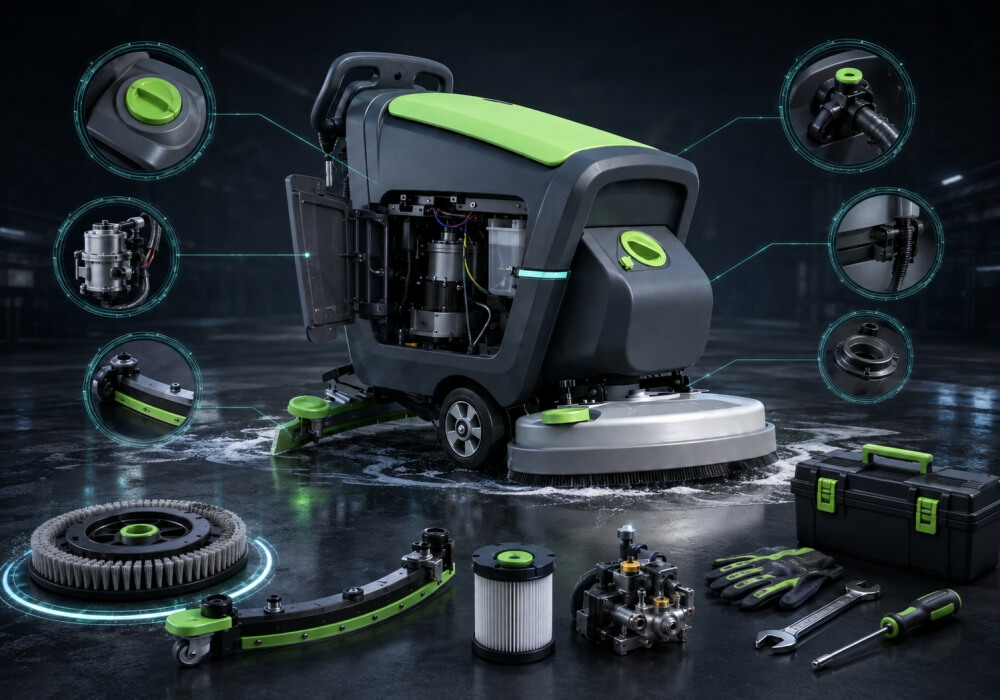
LT-S710X vs LT-S860X floor scrubber comparison shows that the LT-S710X is better suited for facilities needing flexible cleaning with strong maneuverability, while the LT-S860X is designed for larger areas requiring higher coverage and longer working cycles. The choice depends on floor size, cleaning frequency, tank capacity, brush performance, and daily operating conditions. For facilities above 20,000 m², the LT-S860X can reduce interruptions, while the LT-S710X offers better control in mixed environments.
Large commercial and industrial facilities require floor cleaning equipment that can maintain stable performance across long working hours. Ride-on scrubbers are widely used in warehouses, manufacturing plants, airports, shopping centers, and logistics buildings because they allow operators to clean larger areas with less physical effort compared with walk-behind machines.
A facility manager choosing between the LT-S710X and LT-S860X should evaluate cleaning area, floor layout, water capacity, battery duration, and maintenance requirements. A 2024 industry survey of commercial cleaning operations showed that labor efficiency and machine uptime were among the main factors considered when upgrading cleaning equipment, with more than 60% of large facilities prioritizing higher productivity over simple purchase price.
"The best scrubber is not always the largest model. It should match the floor design, cleaning schedule, and expected daily coverage."
The LT-S710X is developed for users who need a balance between cleaning width and operating flexibility. Many commercial buildings contain different floor zones, including open halls, storage areas, corridors, and customer spaces. A machine with moderate dimensions can move more easily between these areas while maintaining consistent cleaning results.
The LT-S860X focuses more on high-area cleaning performance. Large warehouses and industrial plants often contain wide open floors where a larger cleaning path can reduce the number of passes required. When a machine covers more square meters per hour, operators can complete scheduled cleaning tasks within shorter maintenance windows.
| Feature | LT-S710X | LT-S860X |
|---|---|---|
| Main application | Commercial buildings and medium-large facilities | Large industrial spaces |
| Cleaning approach | Flexible operation | High-area coverage |
| Layout suitability | Mixed floor environments | Open floor areas |
| Daily working demand | Regular cleaning schedules | Long continuous cleaning cycles |
| Operator requirement | Easy handling | High productivity operation |
The difference between the two models becomes more noticeable when considering facility size. A building measuring 10,000–15,000 m² may not always benefit from a larger machine because narrow routes and frequent direction changes affect efficiency. In comparison, distribution centers exceeding 25,000 m² can gain more from equipment designed for longer continuous cleaning periods.
Cleaning width directly affects daily productivity. According to commercial cleaning calculations commonly used in facility management, increasing the cleaning path by 15–20% can reduce the total number of passes required when floor conditions remain consistent. However, wider equipment may require more open space for turning and storage.
The LT-S710X provides a practical balance for areas where operators need to move around shelves, equipment, and customer zones. The LT-S860X is more suitable for locations where large uninterrupted surfaces make wider cleaning performance more useful.
Battery capacity and operating time also influence machine selection. Many industrial facilities schedule cleaning during low-traffic periods, such as overnight shifts or early mornings. If charging or refilling interrupts operation too often, the total cleaning area completed per shift may decrease.
For example, a facility operating an 8-hour cleaning schedule may prefer equipment that can complete longer routes without frequent stops. A difference of only 30 minutes of additional productive cleaning time per shift can accumulate into more than 120 working hours over a year in daily-use environments.
The LT-S710X vs LT-S860X floor scrubber comparison also involves water management performance. Ride-on scrubbers rely on solution tanks and recovery tanks to maintain continuous cleaning. Larger tanks reduce the frequency of refilling and emptying, which is especially useful in facilities with large floor areas.
Water consumption is another consideration. Modern cleaning operations often aim to reduce unnecessary water use while maintaining cleaning quality. A properly adjusted solution flow can improve cleaning consistency, especially on concrete, epoxy, tile, and other commercial flooring materials.
Brush pressure and scrubbing performance affect how different floors are maintained. High-traffic areas may collect oil marks, dust, rubber residue, and industrial particles that require stronger mechanical cleaning. At the same time, delicate surfaces may need controlled pressure to prevent unnecessary wear.
| Cleaning Environment | Suitable Model | Reason |
|---|---|---|
| Shopping centers | LT-S710X | Flexible movement between public areas |
| Schools and institutions | LT-S710X | Suitable for different room layouts |
| Manufacturing facilities | LT-S860X | Handles larger cleaning zones |
| Distribution warehouses | LT-S860X | Better for long open routes |
| Large storage buildings | LT-S860X | Reduces cleaning interruptions |
Operator comfort should also be considered because ride-on scrubbers are often used for several hours per day. Seat design, control placement, visibility, and simple operation help maintain consistent performance during long shifts.
In 2023 facility management studies, reducing operator fatigue was associated with improved work consistency, especially in cleaning tasks lasting more than 4 hours. Machines that allow simple controls and comfortable driving positions can help operators maintain the same cleaning quality throughout the shift.
Maintenance requirements create another difference between equipment categories. Commercial users often calculate machine availability over several years rather than evaluating only the first purchase cost. Regular inspection of brushes, squeegees, batteries, and water systems helps extend equipment service life.
A machine used daily in a warehouse may complete thousands of operating hours during its service period. If maintenance procedures are simple and replacement parts are accessible, facilities can reduce downtime and keep cleaning schedules stable.
The LT-S710X and LT-S860X are designed for different operating conditions. The LT-S710X fits organizations that require adaptability across multiple floor types and layouts. The LT-S860X matches facilities where large-scale cleaning speed and extended operation are more important.
"Facility size, floor structure, and cleaning frequency should be evaluated together before selecting a ride-on scrubber."
For smaller commercial locations with changing layouts, the LT-S710X can provide a practical combination of control and performance. For large industrial buildings where operators clean tens of thousands of square meters regularly, the LT-S860X provides a stronger focus on continuous productivity.
The final selection should consider daily cleaning area, working hours, floor conditions, and future expansion plans. A properly matched ride-on scrubber can improve cleaning consistency, reduce manual workload, and support efficient facility management over long-term use.